
In an era where internet censorship is becoming increasingly sophisticated, traditional VPNs are often no longer enough. While tools like OpenVPN and WireGuard are excellent for security, they frequently fall victim to Deep Packet Inspection (DPI). This is where V2Ray enters the scene—not just as a protocol, but as a multi-layered platform designed specifically to bypass the most rigorous digital barriers.
In this article, we’ll explore the unique features of V2Ray, compare it with industry standards, and explain why it remains the go-to choice for users in highly restricted regions.
What is V2Ray?
V2Ray is a part of Project V, a set of tools that help you build your own customized network privacy solution. Unlike a standard VPN that uses a single protocol, V2Ray is a framework that supports multiple protocols (such as VMess, VLESS, Trojan, and Shadowsocks) and various transport methods (like WebSocket, HTTP/2, and QUIC).
Key Features of V2Ray
- Multiple Protocol Support: V2Ray can act as a bridge for several protocols simultaneously.
- Advanced Obfuscation: It can disguise your traffic as normal web browsing (HTTPS), making it nearly impossible for firewalls to distinguish it from regular traffic.
- Dynamic Routing: You can route traffic based on the destination, such as sending domestic traffic through your local ISP and international traffic through the V2Ray tunnel.
- Mux (Multiplexing): This feature improves connection efficiency by sending multiple data streams over a single TCP connection.
V2Ray vs. WireGuard vs. OpenVPN
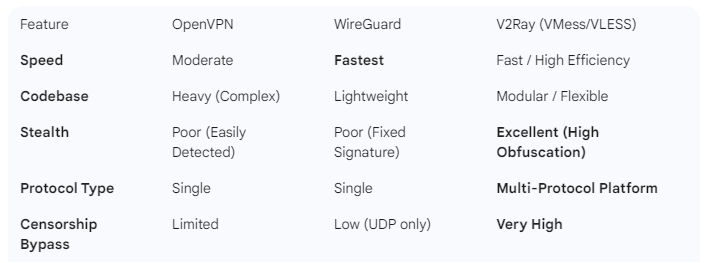
To understand why V2Ray is superior for bypassing censorship, we must compare it to the “big two” of the VPN world.
Why V2Ray Wins Against DPI
-
WireGuard is built for speed and modern crypto, but its traffic has a distinct “fingerprint.” Once a firewall identifies this signature, it can block it instantly.
-
OpenVPN is highly secure but uses a handshake process that is very easy for DPI systems to recognize and throttle.
-
V2Ray uses TLS camouflaging. By using technologies like VLESS with Reality, it mimics a real website’s handshake perfectly. To a censor, your connection looks like you are just visiting a legitimate site like Microsoft or Wikipedia.
Where is V2Ray Most Effective?
V2Ray is specifically designed for countries with “National Firewalls” that use active probing and DPI. It is most popular and effective in:
- China: The birthplace of V2Ray’s core community, designed specifically to beat the Great Firewall (GFW).
- Iran: Highly effective against protocol-based filtering and domestic-only network restrictions.
- Russia: Useful for bypassing ISP-level blocks on international services.
- Turkmenistan & UAE: Effective in regions where VoIP or specific social apps are restricted.
Is V2Ray “Unblockable”?
While no technology is 100% immune to blocking, V2Ray is significantly more resilient.
- Active Probing Resistance: Modern firewalls send “probes” to a server to see if it’s a VPN. V2Ray (especially with the Trojan or Reality protocols) can detect these probes and remain silent or respond like a normal web server.
- IP Blocking: While an IP address can still be blocked, V2Ray’s ability to run over CDN (Content Delivery Networks) like Cloudflare makes it much harder to kill the connection without blocking large chunks of the internet.
Should You Use V2Ray?
If you live in a country with high internet freedom and just want to secure your Wi-Fi, WireGuard is likely your best bet for speed. However, if you are facing strict censorship, ISP throttling, or “VPN-only” blocks, V2Ray is the undisputed champion.